Applied Nuclear Data Assimilation using GLLS#
This example demonstrates the use of the Generalized Least Squares (GLLS) method to improve the prediction of an integral application using experimental benchmark data.
Benchmarks:
HMF001
HMF002-001
Application:
HMF002-002
1. Setup and Imports#
We use andalus for the assimilation logic and matplotlib for visualization, pandas is used to interact with the data.
[ ]:
import matplotlib.pyplot as plt
import pandas as pd

import andalus

plt.style.use("ggplot")
2. Reading Serpent Output#
We use the AssimilationSuite.from_yaml method to easily load in a set of benchmarks / applications and covariance information.
The config.yaml file specifies which isotopes and reactions to include in the analysis.
[2]:
!cat "config.yaml"
# Global settings for the analysis
covariances:
  file_path: "../data/covariances_test.h5"
  nuclear_data_library: "TEST"
  # Optional: backup covariance file path to use if uncertainties in the primary file are unrealistic
  # backup: "../data/covariances_backup.h5"

# List of benchmarks to be loaded into the BenchmarkSuite
benchmarks:
  - title: "HMF001"
    description: "A bare, highly enriched uranium sphere (GODIVA)."
    m: 1.00000
    dm: 0.00100
    kind: "keff"
    sens0_path: "../data/hmf001.ser_sens0.m"
    results_path: "../data/hmf001.ser_res.m"
    flux_det_name: "flux"
    flux_det_path: "../data/hmf001.ser_det0.m"

  - title: "HMF002-001"
    description: "Topsy 8-inch tuballoy reflected oralloy assemblies (sphere)."
    m: 1.00000
    dm: 0.00300
    kind: "keff"
    sens0_path: "../data/hmf002-001.ser_sens0.m"
    results_path: "../data/hmf002-001.ser_res.m"

applications:
  - title: "HMF002-002"
    description: "Topsy 8-inch tuballoy reflected oralloy assemblies (cylinder)."
    sens0_path: "../data/hmf002-002.ser_sens0.m"
    results_path: "../data/hmf002-002.ser_res.m"
    m: 1.00000
    dm: 0.00300
[3]:
assimilation_suite = andalus.AssimilationSuite.from_yaml("config.yaml")
Reading ../data/hmf001.ser_res.m
WARNING:  SERPENT Serpent 2.2.1 found in ../data/hmf001.ser_res.m, but version 2.1.31 is defined in settings
WARNING:    Attempting to read anyway. Please report strange behaviors/failures to developers.
  - done
Reading ../data/hmf001.ser_sens0.m
  - done
Reading ../data/hmf001.ser_det0.m
  - done
Reading ../data/hmf002-001.ser_res.m
WARNING:  SERPENT Serpent 2.2.1 found in ../data/hmf002-001.ser_res.m, but version 2.1.31 is defined in settings
WARNING:    Attempting to read anyway. Please report strange behaviors/failures to developers.
  - done
Reading ../data/hmf002-001.ser_sens0.m
  - done
Reading ../data/hmf002-002.ser_res.m
WARNING:  SERPENT Serpent 2.2.1 found in ../data/hmf002-002.ser_res.m, but version 2.1.31 is defined in settings
WARNING:    Attempting to read anyway. Please report strange behaviors/failures to developers.
  - done
Reading ../data/hmf002-002.ser_sens0.m
  - done
3. Energy-Dependent Sensitivities#
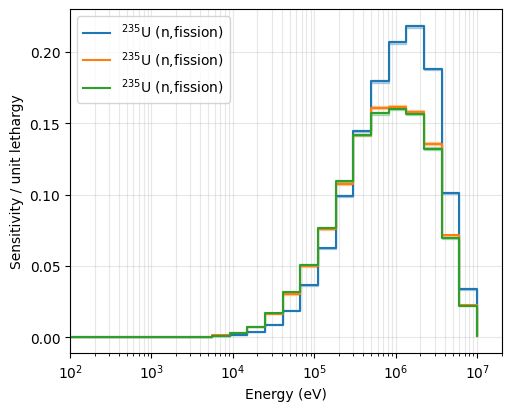
Visualizing the sensitivity profiles helps us understand which energy ranges drive the \(k_{\text{eff}}\) response. Below we compare U-235 fission (MT 18) sensitivities across all systems.
[4]:
zais = [922350]  # U-235
perts = [18]  # Fission (MT 18)

fig, ax = plt.subplots(layout="constrained")

for benchmark in assimilation_suite.benchmarks:
    benchmark.s.plot_sensitivity(zais=zais, perts=perts, ax=ax)

assimilation_suite.applications["HMF002-002"].s.plot_sensitivity(zais=zais, perts=perts, ax=ax)

ax.set(
    xlim=(1e2, 2e7),
)
C:\Users\dhouben\Documents\andalus\andalus\sensitivity.py:246: PerformanceWarning: indexing past lexsort depth may impact performance.
  subset = self.loc[zai, pert]
[4]:
[(100.0, 20000000.0)]
4. Similarity Analysis (\(c_k\) Index)#
The \(c_k\) index quantifies the correlation between systems based on shared nuclear data uncertainties.
Values close to 1.0 indicate that the benchmark is an excellent surrogate for the application.
[5]:
# Print the ck-similarity matrix
ck_matrix = assimilation_suite.ck_matrix()
print(ck_matrix)
              HMF001  HMF002-001  HMF002-002
HMF001      1.000000    0.858986    0.861173
HMF002-001  0.858986    1.000000    0.999814
HMF002-002  0.861173    0.999814    1.000000
[6]:
# Print the ck-similarity values for a specific target
ck_target = assimilation_suite.ck_target("HMF002-002")
print(ck_target)
HMF001        0.861173
HMF002-001    0.999814
Name: HMF002-002, dtype: float64
We can see that HMF002-001 has more than 99% of the nuclear data uncertainties with regards to keff in common, meaning that if we reduce the nuclear data uncertainties in HMF002-001, we will also reduce the uncertainty in predicting keff with regards to the uncertainties due to nuclear data in HMF002-002.
5. Performing the GLLS Adjustment#
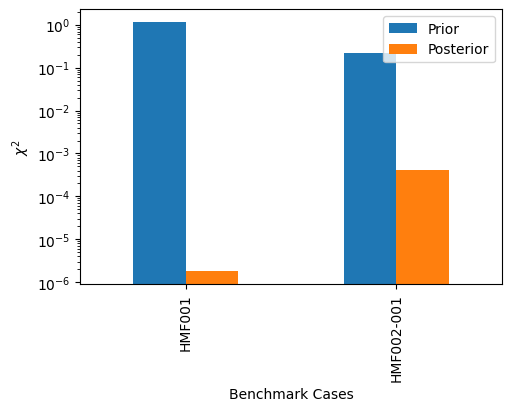
We now calculate the posterior suite. This updates the nominal values (\(\mathbf{c}\)) and reduces the covariance matrix based on the experimental evidence from the benchmarks.
[7]:
posterior_suite = assimilation_suite.glls()

# Compare Chi-Squared reduction
chi_comparison = pd.DataFrame(
    {
        "Prior": assimilation_suite.individual_chi_squared(nuclear_data=False),
        "Posterior": posterior_suite.individual_chi_squared(nuclear_data=False),
    }
)

fig, ax = plt.subplots(layout="constrained")

chi_comparison.plot.bar(ax=ax)

ax.set(
    yscale="log",
    ylabel="$\\chi^2$",
    xlabel="Benchmark Cases",
)

plt.show()
Performing GLLS update on the assimilation suite...
    Number of benchmarks included in GLLS: 2
    Prior chi-squared with nuclear data: 0.0095
    Prior chi-squared without nuclear data: 1.3981
    Posterior chi-squared with nuclear data: 0.0002
    Posterior chi-squared without nuclear data: 0.0004
6. Summary of Results#
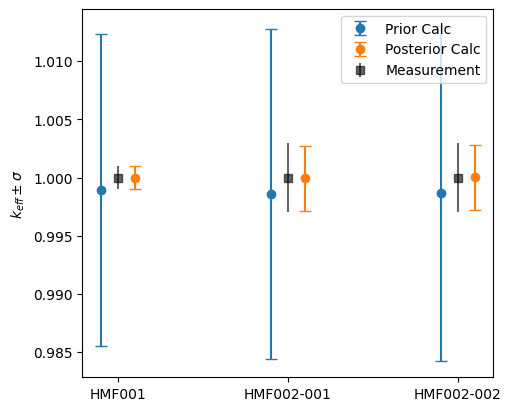
The plot below shows the \(k_{\text{eff}}\) predictions. Note how the Posterior values for the target application (HMF002-002) move significantly closer to the experimental measurement, even though that specific system was not used in the adjustment. This is because HMF002-002 is highly similar to HMF002-001, therefore correcting for the behaviour of one improves the prediction for the behaviour of the other one as well.
[8]:
prior_unc = assimilation_suite.propagate_nuclear_data_uncertainty()
post_unc = posterior_suite.propagate_nuclear_data_uncertainty()

fig, ax = plt.subplots(layout="constrained")

x = range(len(assimilation_suite.titles))
ax.errorbar([i - 0.1 for i in x], assimilation_suite.c, yerr=prior_unc, fmt="o", capsize=4, label="Prior Calc")
ax.errorbar([i + 0.1 for i in x], posterior_suite.c, yerr=post_unc, fmt="o", capsize=4, label="Posterior Calc")

ax.errorbar(
    x,
    assimilation_suite.m,
    yerr=assimilation_suite.dm,
    fmt="s",
    color="black",
    label="Measurement",
    alpha=0.6,
)

ax.set_xticks(x)
ax.set_xticklabels(assimilation_suite.titles)
ax.set_ylabel("$k_{eff} \\pm \\sigma$")
ax.legend()
plt.show()